
The Nexus
06 Sept, 2026
By
Joshua Mirrer, M.D
Extraction All the Way Down
Extraction All the Way Down — Joshua Mirrer, M.D
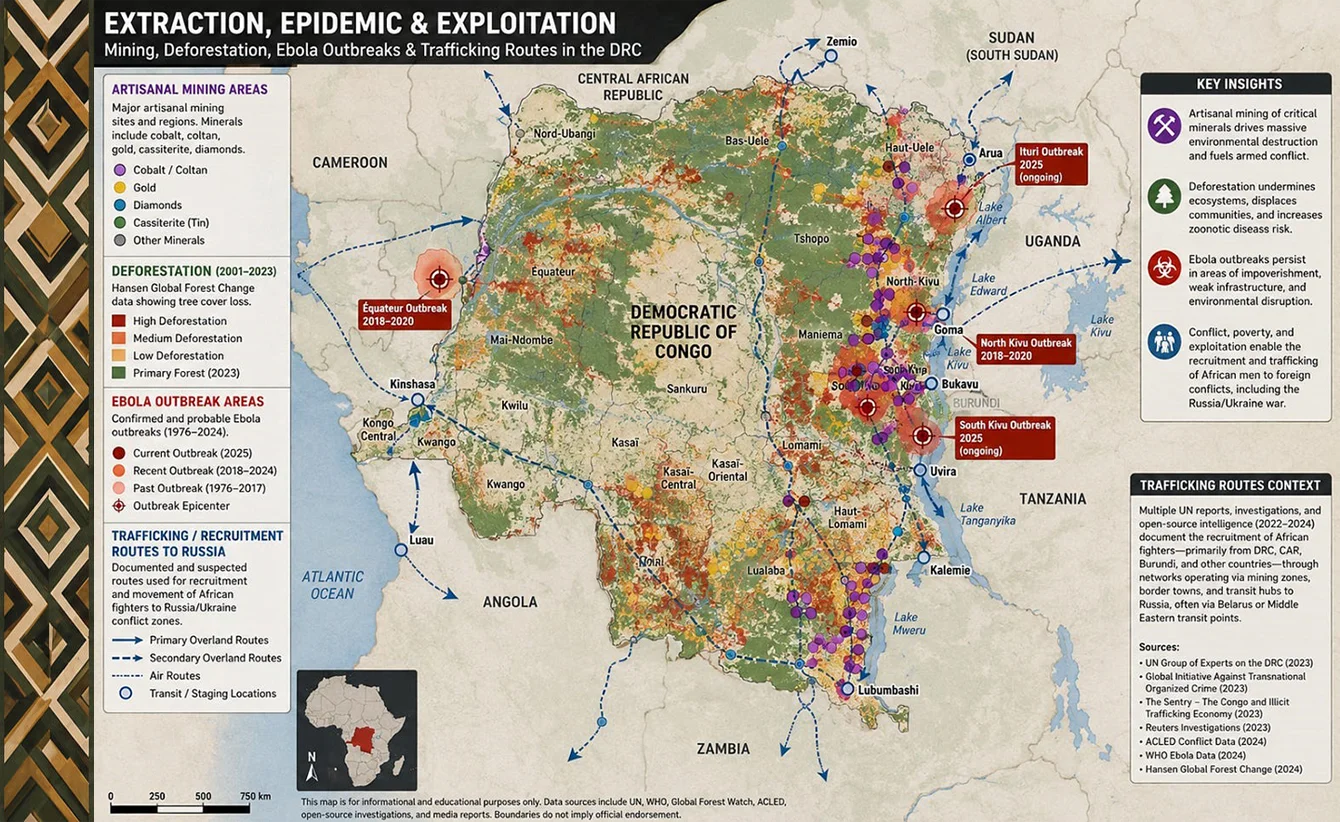
What do Ebola, cobalt, deforestation, and human trafficking have in common?
There is something almost theological about the modern supply chain. We are trained to see only the finished object while remaining blind to the sacrifices required to produce it.
The smartphone arrives polished and weightless in the palm of the hand, appearing almost detached from the Earth itself. But hidden within it are cobalt, tantalum, copper, gold, tin, lithium, and tungsten pulled from landscapes most consumers will never see and extracted by people whose lives remain largely invisible to the global economy they sustain.
The Democratic Republic of Congo supplies much of the world’s cobalt, a mineral essential for batteries, electronics, and the infrastructure underlying the technological future. Much of this extraction occurs through artisanal mining, where individuals and families dig by hand through unstable earth in conditions defined by poverty, toxic exposure, violence, and exploitation. The word artisanal evokes craftsmanship, something almost quaint or romantic. The reality is closer to economic desperation.
In parts of Katanga and other mining regions, children work underground or sort ore at the surface while exposed to arsenic, cadmium, lead, and uranium. Dust from crushed ore settles into lungs and drinking water alike. Researchers studying mining communities in the Congo have found elevated concentrations of heavy metals in the blood and urine of both miners and nearby residents, including children who never enter the mines themselves but live beside tailings piles or contaminated streams. Prolonged exposure has been linked to respiratory disease, neurological damage, birth defects, kidney failure, developmental disorders, and cancers that often go untreated in regions with little meaningful access to healthcare.
The labor itself is brutally physical. Miners descend into narrow hand-dug shafts vulnerable to collapse, often without protective equipment, ventilation, or structural reinforcement. Fatal cave-ins are common and frequently underreported. Injuries that would be survivable elsewhere become life-ending in areas lacking trauma care or basic medical infrastructure. Life expectancy in heavily exploited mining zones can fall dramatically below national averages, not only because of toxic exposure and workplace accidents but because extraction economies destabilize nearly every surrounding social institution.
Mining camps attract transient populations overwhelmingly composed of men with little economic security and almost no regulatory oversight. Around these camps, sexual violence proliferates with horrifying regularity. Women and girls are frequently coerced into transactional sex for food, transport, protection, or access to mining sites themselves. Human rights investigations have documented rape, trafficking, forced prostitution, and sexual abuse committed by armed groups, security personnel, and miners alike. Children are particularly vulnerable. Some work directly in the mines; others are exploited in the informal economies that emerge around them. In many communities, school attendance collapses because families depend on mining income to survive, pulling children permanently out of education and into cycles of labor and exploitation that can persist across generations.
Environmental contamination compounds the damage. Rivers become polluted with runoff from ore processing. Forests are stripped for fuel and expansion. Agricultural land degrades, making subsistence farming increasingly difficult and forcing even more people into dependence on extraction work. Entire local economies become reorganized around mining because extraction is often the only viable path to survival, even as it steadily destroys the conditions necessary for long-term social stability.
Yet even this framing remains incomplete because mining itself does not exist in isolation. The mine expands into the forest. Roads cut deeper into previously undisturbed ecosystems. Informal settlements appear around extraction sites, thereby displacing wildlife. There are no local stores or settlements, so hunting increases. Human beings end up entering ecological spaces that previously maintained a degree of separation between viral reservoirs and civilization. This is where the story of cobalt converges with Ebola.
We often discuss outbreaks as though they emerge from nature independently of human systems, as though viruses simply erupt from the wilderness without cause. But ecological disruption alters the boundaries between species. Deforestation, mining expansion, forced migration, and resource extraction increase contact between humans and animal hosts while simultaneously weakening public health infrastructure through instability and poverty.
The Congo Basin is not only one of the most resource-rich regions on Earth. It is also one of the planet’s most important ecological stabilizers. And increasingly, it is being carved apart in service of global demand for technological infrastructure. The same economic system demanding renewable energy transitions, battery production, cloud computing infrastructure, artificial intelligence expansion, and semiconductor manufacturing is also accelerating the destruction of one of the most biologically complex regions in the world.
The contradiction is difficult to ignore. The modern world increasingly speaks the language of sustainability while externalizing the environmental and human cost of sustaining itself. But the logic of extraction does not stop with minerals or forests; it extends to people themselves.
Recent reports have documented Russian recruitment operations targeting vulnerable populations across Africa with promises of employment, education, security work, or migration opportunities. Many recruits reportedly discover only later that they are being transported into the machinery of war in Ukraine. Some are coerced into military contracts written in languages they cannot read. Others are trapped by debt, confiscated documents, or false promises of citizenship and employment. Once again, desperation becomes infrastructure.
The same conditions that drive individuals into artisanal mines—poverty, instability, weak governance, debt, unemployment, and the collapse of opportunity—also create populations vulnerable to trafficking and military exploitation. Human beings become another extractable resource within geopolitical competition. Just as multinational corporations extract cobalt from Congolese soil while externalizing the consequences onto local communities, powerful states increasingly extract labor and bodies from economically fractured regions to sustain distant conflicts.
None of these crises exist independently. The child sorting cobalt ore, the miner clearing forest for extraction, the village facing viral spillover, and the trafficked recruit arriving on a Ukrainian battlefield are all connected through systems that convert vulnerability into economic utility. This is what modern externalities look like.
They are not abstractions on a balance sheet. They are ecological collapse displaced across borders. They are diseases emerging from destabilized ecosystems. They are children abandoning school to enter toxic mines. They are human beings trafficked into war under false pretenses. They are entire regions forced to absorb the hidden costs of maintaining the consumption patterns, geopolitical ambitions, and technological acceleration of the developed world. The part that continues to frustrate me is not merely that these systems exist. It is that they are functioning exactly as designed.
For decades, neoliberal globalization has operated on the assumption that efficiency is synonymous with morality. If markets optimize production, then whatever emerges from the market must represent progress. But markets optimize for extraction just as efficiently as they optimize for innovation. They reduce forests into timber reserves, rivers into industrial inputs, minerals into commodities, and eventually human beings into labor pools, migration statistics, or military assets. The result is a civilization increasingly incapable of distinguishing technological advancement from civilizational health.
We celebrate the electric vehicle while ignoring the mining camp. We celebrate semiconductor independence while ignoring the forests being fragmented to acquire rare earth minerals. We discuss artificial intelligence as the future of humanity while entire populations remain trapped in conditions resembling colonial extraction economies. And then we express surprise when outbreaks spread, ecosystems collapse, governments destabilize, and violence proliferates outward across borders. But these are not interruptions of the system; they are products of it. Eventually, even the soul becomes an economic externality.
It is extraction all the way down.
Share with your friends


Join The Community
Get the latest analysis, exclusive content, and event updates delivered to your inbox

Connect
Independent analysis and dialogue at the intersection of Africa and the United States.