
The Nexus
07 Sept, 2026
By
Baimba Yilla, Ed.D
Making Strangers
Making Strangers — Baimba Yilla, Ed.D.
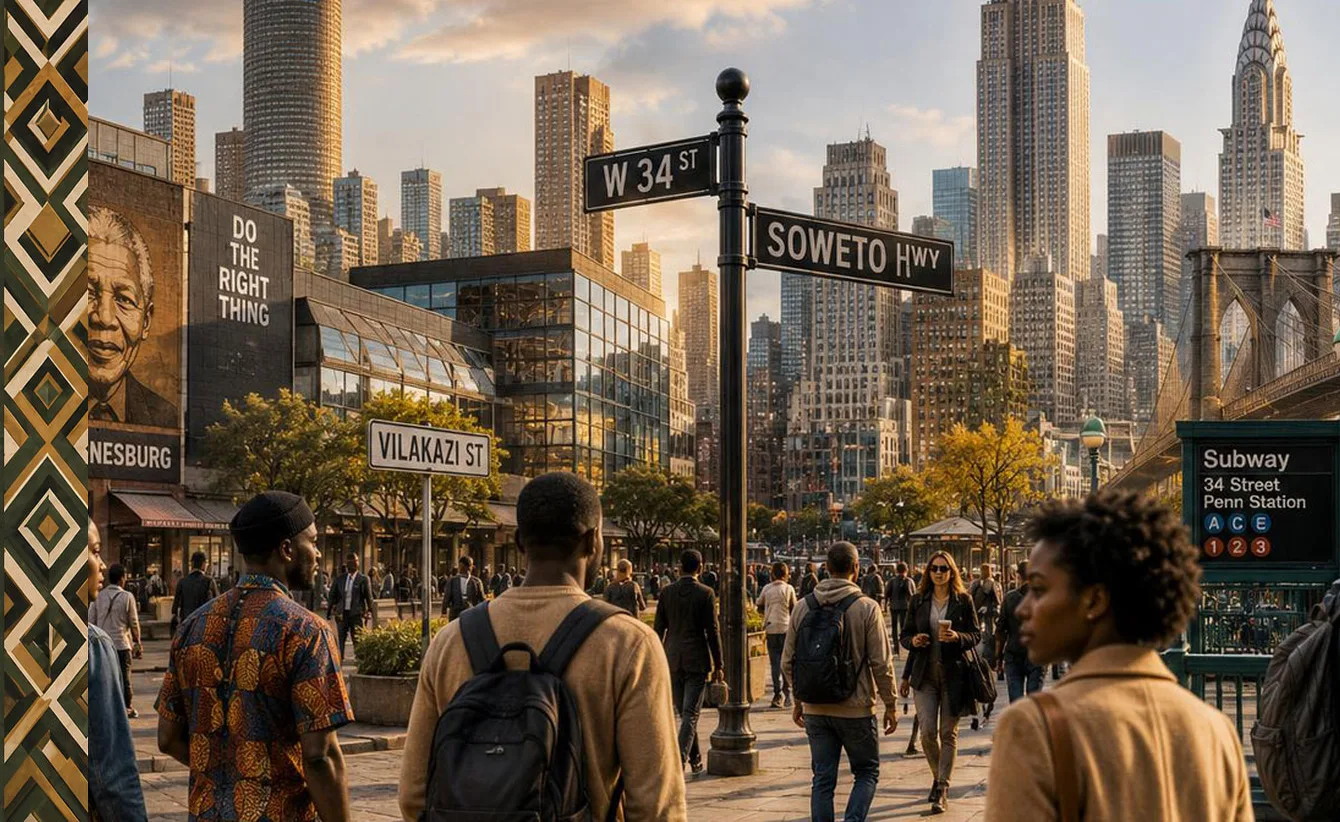
“Hostility toward foreigners has intensified across countries. Nowhere do these tensions appear more pronounced—or more revealing of the precarious nature of our shared humanity—than in South Africa and back home in the United States.”
Afro Corner in the central business district of Cape Town is the definition of a hidden gem. This no-frills spot in South Africa’s Mother City offers some of the best hair braiding services you will find, not just in the city, but anywhere in the world.
Impressed with the quality of their work during a recent visit for our daughters, I could not resist striking up a conversation with the owners behind the operation, a middle-aged Zambian woman and her Congolese husband, who escaped Mobutu Sese Seko’s impoverished Zaire in 1997 for a better life in Johannesburg only months before the autocratic was ran out of the country.
Our conversation offered far more than I had anticipated, not least because it brought some clarity to what had, until that moment, defied easy explanation: the national conversation and political movement that had come to dominate South Africa's public discourse since our arrival in mid-June from the United States.
To hear the owners tell it, Afro Corner thrives because of the wealth of talent they bring together. Women from across Africa work shoulder to shoulder, combining their expertise to halve the time it takes to braid a client’s hair while creating flawless styles that reflect the artistry, precision, and rich heritage of African braiding traditions.
But their success is overshadowed by the realities of their daily lives, shaped by the very challenges absent from an increasingly heated national debate over illegal immigration—a debate that many South Africans now see as central to the country's economic hardships and that has fueled a movement which, at times, teeters on the brink of xenophobic violence.
Among their talented workers, the owners shared, are Ghanaians, Cameroonians, Zimbabweans, Botswanan, and Nigerians, citizens of other African nations accustomed to the grind of immigrant life, where resilience is less a choice than a daily necessity and opportunity is earned through long hours, uncertainty, and constant sacrifice.
Not one of the stylists in the crowded salon was South African, however, a fact the owners shared with equal parts disbelief and apprehension, given the charged debate unfolding beyond their doors over what immigrants are supposedly taking from ordinary South Africans. They said they had repeatedly hired South African citizens, only to see them leave within weeks of receiving their first paycheck.
"South Africans just don't want to work," the wife concluded, her voice tinged with quiet frustration as she struggled to understand what was driving so much hostility toward immigrants—both those creating jobs and those willing to do the work many South Africans seem unwilling to do.
Her observation was less provocative, derisive even, than revealing, offering a window into a vexing social phenomenon that has taken hold around the world.
To be sure, hostility toward foreigners has intensified across countries, While the reasons often appear rooted in social fault lines unique to each country, the underlying forces are remarkably similar: economic insecurity, political opportunism, and the search for simple explanations to complex problems like endemic corruption.
What is taking place in Jordan, Ireland, France, India, South Korea, Canada, and Tunisia, to name but a few, is emblematic of a broader trend in which immigration has become a focal point for socioeconomic and political anxieties, many of them rooted in domestic challenges as much as in migration itself.
Yet nowhere do these tensions appear more pronounced—or more revealing of the precarious nature of our shared humanity—than in South Africa and back home in the United States, where immigration has also become a vehicle for broader political and social anxieties, even as the motivations and circumstances seem markedly different.
Here is the reason why.
The Afro Corner owner's assessment of South Africans' work habits is, of course, subjective, but it does not diminish the broader point she quietly suggested. The forces shaping immigration in South Africa run deep, not least among them the country's political culture and the norms that have taken root within its institutions.
South Africa under the latter years of Thabo Mbeki and the subsequent decade of Jacob Zuma offers ample evidence, from the country's infamous Arms Deal and the Nkandla upgrades to State Capture, the Gupta family's influence over government, and procurement corruption within state-owned enterprises.
These scandalous episodes of high-level financial malfeasance came to symbolize corruption that had evolved beyond isolated acts of bribery into the systematic capture of public institutions by private interests.
They also created conditions in which illegal immigration could flourish, allowing foreigners so inclined to enter South Africa unlawfully and, through bribery and the complicity of officials at multiple levels of government, obtain work and residency permits—gaining access to benefits reserved for South African citizens in some cases.
The weight of these experiences was palpable, yet expressed with remarkable restraint, reflecting a people who had long endured neglect while continuing to place their faith in the rule of law.
Then came Phala Phala: the 2020 burglary at the sitting president's private game farm, during which hundreds of thousands of dollars in cash—reportedly proceeds from the sale of valuable cattle to a foreign buyer—were stolen from the property.
On top of the main focus of the subsequent inquiry—the reporting of the burglary, the source and storage of the foreign currency, possible exchange-control violations, and the conduct of the president and state officials—there were allegations, not officially investigated, of undocumented workers being employed at the game farm.
As South Africans searched for answers to their worsening economic conditions amid persistent high levels of violent crime, many connected the dots to what was most visible, concluding that illegal immigration was a significant source of those problems while also questioning whether the country's immigration laws—and the rule of law in general—were being applied consistently, even at the highest levels of government.
Phala Phala ultimately reinforced a broader crisis of trust in government, compounded by the ruling party's decision in December 2022 to block a parliamentary impeachment inquiry related to the affair—a process only recently revived by a Constitutional Court ruling.
This transformation of immigration into a proxy for far deeper anxieties in South Africa is reminiscent of the way the issue has metastasized at home in the United States.
Economic insecurity is a powerful driver in both nations. And much like in South Africa, some American political leaders have actively amplified anti-immigration sentiment by appealing to fears over jobs, wages, public services, and crime—rendering immigrants as vessels into which ordinary citizens pour anxieties that are only partly about the immigrants themselves.
But an even deeper moral dilemma emerges in the United States, where public frustration has become fodder for political mobilization—a means to a specific political end, with legislation and executive orders that many argue are intended to slow the country's shift toward a majority-minority population and preserve a more homogeneous national identity.
The massive shift in U.S. immigration policy following the 2016 and 2024 elections, travel bans, orders to end birthright citizenship (which the Supreme Court has recently overturned), and mass deportations in particular, are the direct result of this ideological mission, political goals perpetuated by some of the country’s leaders personal grievances about who belongs in America.
But enacting policies such as mass deportation to answer questions of national identity and belonging, given the hostility underpinning them in a country that still seeks to maintain the pretense of racial equality, is politically challenging and requires careful political dance to make them publicly palatable, as journalist Jean Guerrero explained in the context of her research on one of the principal architects of current US immigration policies.
She said “making the re-engineering of demographics in this country into something that had to do with keeping Americans safe or preserving America’s jobs...putting it in language that appeals to the mainstream and doesn’t seem to be about race” became the linguistic framing of choice to help enact the policies.
“But when you actually connect the dots between what these think tanks [whose anti-immigration policy blueprints the Trump Administration copied] are pushing for and where they’re deriving their ideas, it all comes down to white supremacy and this idea that you need a white majority in this country.”
Guerrero says plainly what inspires some of America’s elected leaders to leverage immigration—an obsession with perceived difference and a desire to return America to its supposed cultural roots.
So, unfolding in both countries is two sides of the same coin: in South Africa, people who have lived side by side for decades are made into strangers through economic frustration, and in the United States, migrants are cast as outsiders in service of a political vision of national identity.
Intentional acts such as these render immigration not merely a policy issue but a potent political instrument in broader debates over economic security, national identity and, above all, the future of nation states and the people within them—exposing just how fragile human solidarity becomes when economic insecurity and politics are leveraged to redefine who belongs.
These were precisely the concerns the owners of Afro Corner articulated as they reflected on their experience in South Africa. Their focus extended far beyond themselves, to the survival of the very community they had come to embrace as their own.
“How can they look at us and think we are the problem?” the husband asked from behind the locked metal security gate of their salon, a barrier that had become a symbol of the widening divide.
Leaving Zaire meant escaping the poverty of government neglect in pursuit of the dignity that hard work in South Africa seemed to promise. After 30 years, being cast as the problem instead of the government's failures felt like a profound betrayal by a country and a community he had long considered home.
As in the United States, immigration is being weaponized to deflect attention from the real sources of South Africa's problems, including the political calculations of leaders who exploit public frustration for their own ideological ends. Every society must decide whether it will make strangers or make citizens. That choice begins not at the border, but in the stories we tell about one another—and in our willingness to question those who profit from turning fear into policy.
Share with your friends


Join The Community
Get the latest analysis, exclusive content, and event updates delivered to your inbox

Connect
Independent analysis and dialogue at the intersection of Africa and the United States.