
The Nexus
01 Oct, 2026
By
Joseph Kanjirawaya
The Other Side of an African Manifesto: Part 1
The Celebration After the Storm— Joseph Kanjirawaya“After every celebration, reality returns carrying the questions nobody wanted to ask.”
The noise came first. Not the kind that unsettles—but the kind that reassures. The kind that tells people something has ended, and something else, something better, has begun.
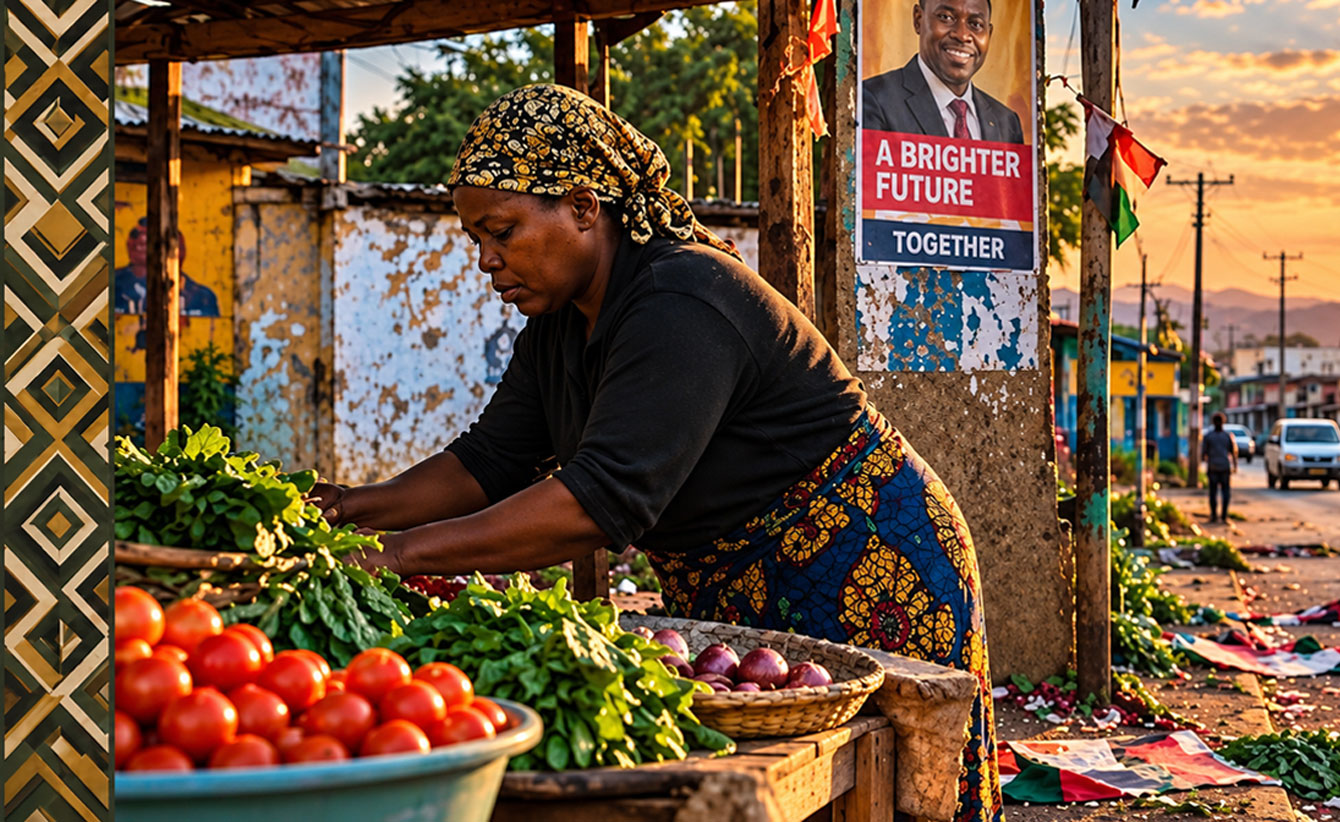
Voices rose into the air, layered over one another—laughter, slogans, songs, declarations. Car horns became instruments. Dust lifted from the roads as feet moved with purpose—some dancing, some marching, some simply following the direction of sound.
It was celebration. Or at least, it looked like it.
In many African countries, elections are not merely political events. They are moments when imagination briefly outruns memory. Years of frustration, hope, anger, and longing gather around a single act—a mark on paper asked to speak louder than history.
And when that moment passes, what remains is not silence—but release.
People celebrate not because everything has changed, but because something might. For a moment, hope borrows the voice of certainty. And in human experience, possibility has always carried a strange power. It can make a distant possibility feel already within reach. It can make a locked door feel as though it has already opened. For a brief moment, tomorrow borrows the face of today.
That distinction is rarely spoken aloud. It lingers between smiles and chants, somewhere in the space between what has happened and what people desperately want to believe has happened. Because to question the moment is to disturb it. To hesitate is to appear ungrateful. And so many choose not to interrupt celebration with reflection.
Hope, after all, is easier to carry when many hands are carrying it.
But beneath the noise, life does not pause. The same roads remain uneven. The same conversations return in quieter tones. The same calculations—of money, of opportunity, of survival—begin again, almost before the music has stopped.
There is a strange coexistence between celebration and reality. One does not cancel the other. They move beside each other, like two rivers flowing in the same direction without becoming one.
The celebration is not false. It is simply unfinished. It is not a conclusion—but a projection. An expression of desire briefly mistaken for evidence.
There is something deeply human in that. To celebrate before arrival is not necessarily ignorance. It is longing. It is the refusal to remain imprisoned by memory. The insistence that tomorrow does not have to resemble yesterday.
Hope is often mistaken for optimism. But they are not the same. Optimism expects the weather to clear. Hope carries an umbrella without knowing whether the rain will stop. Hope does not promise an outcome. It simply refuses to surrender the possibility of one.
And yet even hope can cast a shadow. Because when celebration begins to feel like conclusion, questions become inconvenient. Scrutiny softens. The distance between promise and performance is allowed to grow quietly, protected by the emotional memory of the moment.
The mind, once comforted, does not always hurry back to examine what comforted it.
So attention begins to drift. Not abruptly. Almost politely. What was once questioned closely is accepted more easily. What demanded answers begins settling for reassurance. And slowly, the extraordinary returns to the ordinary.
Nothing has necessarily gone wrong. The rhythm is simply familiar. A rhythm repeated so often that it begins to feel like nature.
Anticipation rises. It reaches its highest point. Then it recedes, leaving behind just enough belief to prepare the ground for another beginning.
Elections do not only produce leaders. They produce emotional transitions. For a brief period, people step outside the weight of lived reality and stand inside imagined possibility. Uncertainty begins to resemble opportunity. Waiting begins to feel like movement. And for some, that feeling is enough.
But time has a way of restoring proportion. Not suddenly. Not loudly. It works in small increments.
A promise is revisited. A delay is explained. A decision is questioned—first in whispers, then in measured voices. And with each passing moment, the distance between imagination and experience becomes a little easier to see.
Not to everyone. Not at once. But enough.
Enough for conversations to change. Enough for certainty to soften. Enough for celebration to acquire a different meaning.
Not an ending—but the beginning of questions.
And perhaps that is where the real story begins. Not in the noise, but in what follows it. Not in declarations, but in details.
Because change rarely arrives with the same energy as hope. Hope can fill a street in an afternoon. Change must survive the morning after. Hope can live on a song.
Change must eventually find its way into the kitchen, the classroom, the clinic, the market, and the road home. That is where promises lose their polish and meet the weight of ordinary life.
And the world is rarely impressed by applause.
So the question is not whether people were right to celebrate. They were celebrating something real—the possibility of a different tomorrow. The deeper question is what happens after possibility has been mistaken for arrival.
Was it victory? Or the idea of victory? Was it change? Or simply the first glimpse of a door that had not yet opened?
These questions do not weaken the celebration. They deepen it. They move it from spectacle toward awareness.
Because to celebrate is human. But to remain awake after the celebration—that is something else.
It is the beginning of consciousness.
And consciousness does not require noise. It grows quietly. In observation. In memory. In the courage to remain present after the music has faded.
The storm, it seemed, had passed. The streets were still carrying the dust of celebration. The flags were still moving in the wind. The songs had not yet disappeared completely.
But somewhere beyond the noise, the ordinary morning was already waiting.
And perhaps that is the part we are least prepared for. Not the storm. Not even the celebration. But the morning after—when the country wakes up, and possibility is asked to become reality.
— I was there. I saw us. I wrote it down.
Share with your friends


Join The Community
Get the latest analysis, exclusive content, and event updates delivered to your inbox

Connect
Independent analysis and dialogue at the intersection of Africa and the United States.