

The Nexus
08 Sept, 2026
By
Baimba Yilla, Ed.D
The America Africa Sees and the America It Doesn't
The America Africa Sees and the America It Doesn't — Baimba Yilla, Ed.D.
“The irony is that there is poverty in America—an abundance of it—concentrated within communities and populations that have too often been overlooked, revealing that many of the same forces that constrain economic opportunity across much of Africa also exist in the United States.”
People were eager to engage, pinning for a sense of life across the Atlantic, as revealed during my chance meeting with an ABSA bank teller at Canal Walk, the sprawling commercial and entertainment hub that was, until recent years, Africa’s largest mall.
The elder millennial dad of two young boys gave me a cool reception when I went to his window to complete my currency exchange, even making me wait a painstaking 45 minutes while he took his lunch break. The delay was off-putting, of course, creating a needless tension that was not easy to overcome—until, when he finally returned, I asked him for crisp bills to take home as souvenirs.
The noticeable chill between us quickly evaporated as the teller warmed up, asking questions about "life on that side." The climate, food, and environment all came up, laying the groundwork for what he wanted me to elaborate on: the conditions that made wealth not only possible but enduring.
To many South Africans like the bank teller I met, the United States appears divided politically, with social tensions that often dominate international headlines. Yet those divisions, they assess, do not seem to have prevented the country from generating wealth and opportunity on a scale that remains difficult to imagine in many parts of the world.
The assessment leads many to view Americans as generally well-off, a perception reinforced by decades of exposure to Hollywood, American music, social media, and the global reach of U.S. brands and technology.
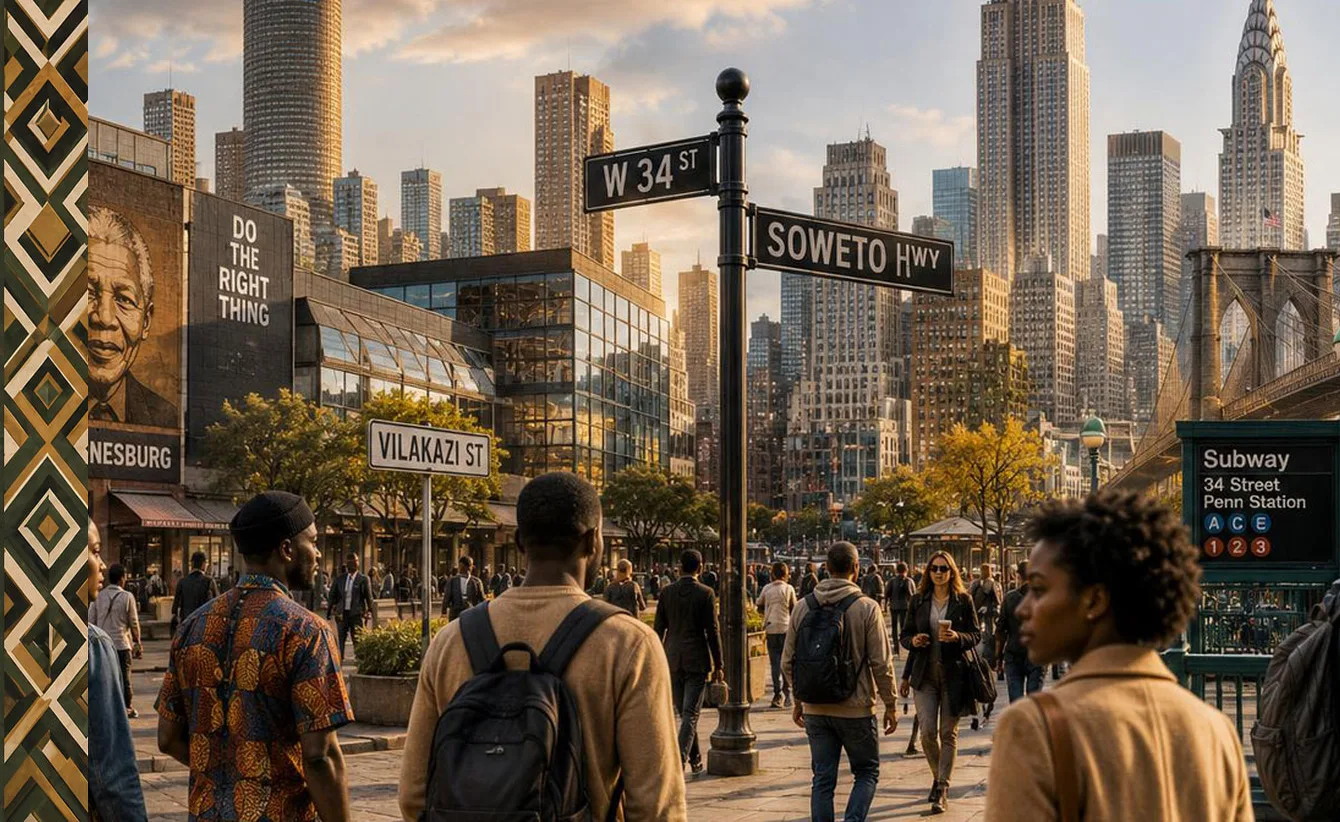
This inflated view of Americans is not unique to South Africa. It is a pattern I have encountered across much of the continent, and it is largely because the images that travel most easily across borders are often those of affluence—large homes, consumer abundance, high salaries, and lifestyles that appear comfortably middle class by American standards but exceptional elsewhere.
The irony is that there is poverty in America—an abundance of it—concentrated within communities and populations that have too often been overlooked, revealing that many of the same forces that constrain economic opportunity across much of Africa also exist in the United States.
Political polarization, for example, unequal access to quality education, concentrated wealth, institutional failures, historical inequities, and naked bigotry all shape economic outcomes on both sides of the Atlantic. The difference is often one of degree rather than kind.
Our own family's experience illustrates this reality. While we were living in what had been a comfortable middle-class life in Virginia during my youth, Dad was murdered at the height of his earning potential, just as he was building an entrepreneurial venture that promised lasting financial security.
He was killed during a dinner in Conakry, Guinea, where he had traveled to open a subsidiary of his newly established gemstone business. Founded in the United States, the enterprise was intended to attract American investment to Africa, expand economic opportunity, and contribute to the continent's long-term development.
Unbeknownst to him, the host of the dinner—a man he trusted completely—had poisoned his meal with rat poison in an attempt to seize the very business they had gathered to celebrate. In a single evening in May 1990, a venture built on trust, partnership, and shared ambition ended in calculated betrayal and irreversible loss.
Dad's murder erased our family’s economic foundation. In the years that followed, Mom struggled to keep our family afloat as she raised my two sisters and me in subsidized government housing, where drug trafficking and street prostitution were part of the everyday landscape.
Working for minimum wage, Mom faced impossible financial choices: whether to pay the utility bill or buy groceries, whether to meet today's obligations or postpone tomorrow's. Poverty was not simply a lack of income; it was the relentless pressure of knowing that hard work alone could not close the gap between survival and stability.
We were not alone.
Around us were countless families facing similar challenges—some struggling under the weight of unavoidable hardship, others harmed by exploitation, neglect, or failures of public institutions. What we all endured was poverty, the kind that narrows choices, limits opportunity, and turns even ordinary setbacks into enduring crises, the same condition that shapes the lives of millions across Africa—not because of any deficiency in its people, but because of circumstances.
The experience became a defining lens through which our family came to understand the world. It revealed how power, greed, and resentment can erode trust and distort human judgment, leading people to inflict profound harm on others. Those lessons did not fade with time. If anything, they made it easier to recognize the same dynamics wherever they emerged.
I encountered them again in South Africa. During an earlier visit, I met a man young named Itumileng, whom I was able to see again when I returned this past June. He had not lost a loved one to violence as my family had, but his livelihood was nonetheless threatened by colleagues who viewed his expertise, relationships with clients, and professional success as something to be undermined rather than valued.
None of what eventually troubled him was visible when we met at his workplace in 2016. Back then, the company he worked for benefited from his knowledge of its products and his ability to communicate their value with the touch of an expert and the energy of a man of the people.
But as South Africans will readily admit, it can sometimes be hazardous for an African employed by certain European-owned companies with predominantly European management to display a level of competence that unsettles those above him.
A few years of his “upstaging” in front of a a growing African middle class clientele the company tried to cultivate was enough to render Itumileng persona non grata, someone whose talents had been welcomed only so long as they served others, not when they outshone them.
His was let go just as the Covid-19 pandemic rattled the world, branded as unfit despite years of dedicated service and left to rebuild his life from scratch in a country where unemployment, per government statistics, hovers over 32 percent (40.6 percent for those between 25-34 years of age).
The impact of the firing on his family, including two young children and a long line of relatives who depended on him, was far-reaching, affecting every aspect of their daily lives in Kayamandi, a township on the outskirts of Stellenbosch, where many residents face overcrowded housing and strained infrastructure amidst limited economic opportunities.
Such pre-existing living conditions make the loss of a stable income, as Itumileng experienced, especially devastating and deepen the hardship of poverty for those left to cope without it, not unlike that experienced in many of America’s low-income neighborhoods and public housing communities.
Indeed, what many Africans do not fully appreciate, through no fault of their own, is that beneath America's image of abundance lies a more complicated reality. Millions of Americans live paycheck to paycheck, navigating stagnant wages, rising housing costs, medical debt, and economic insecurity through resilience and persistence.
Others experience chronic poverty that, while often less visible in the country's global image, is no less devastating to those who endure it. Yet America's immense wealth and economic productivity continue to obscure these realities abroad—precisely what crystallized in my conversation with the bank teller.
As our conversation turned to his eighth-grade son, whom the teller hoped would one day play baseball at an American school, the teller smiled and said that at least I would never have to worry about my children's future.
He meant it as a simple statement of fact. In his mind, America itself was the assurance—a place where opportunity was so abundant that success required little more than taking hold of it; institutions still offer pathways to upward mobility, and even those facing economic challenges enjoy a standard of living that appears enviable by comparison.
That perception is rooted in real differences in income and infrastructure, but it also reflects the selective image of America that much of Africa, and indeed much of the world, encounters.
The paradox, then, is that Americans and Africans often grapple with many of the same structural obstacles to prosperity, even if those obstacles operate in vastly different economic contexts and produce different outcomes.
Recognizing this does not diminish the profound differences between the two; rather, it reveals a shared human reality that is too often obscured by assumptions about wealth and poverty. There is, in fact, far more that connects the United States and Africa than is commonly acknowledged.
It is in recognizing these unexpected points of convergence—not only in shared aspirations but also in shared challenges—that genuine understanding begins and more authentic ties between Americans and Africans can emerge.
Share with your friends

Join The Community
Get the latest analysis, exclusive content, and event updates delivered to your inbox

Connect
Independent analysis and dialogue at the intersection of Africa and the United States.